With GCSEs coming up fast, many of my students have been asking how to revise for different subjects. As such, I’m going to take a break from my usual topics to tell you how I revised for my GCSE exams in order to get the grades to go to Oxbridge.
Despite preferring literature and languages, I got all 9s in my GCSE Science exams. How? Simply through hard work. Although the same methods don’t work for everyone, I hope that by sharing how I planned and executed my revision I might be able to help some of you feel more confident in the run up to May and June!
Set yourself up for success
However tempting it may be, it is crucial to avoid spending hours and hours writing out a beautiful, colour-coded and overly optimistic revision timetable. The vast majority of students will never be able to stick to such schedules, and seeing yourself fail to live up to impossible standards every day will only hinder your revision. So the question is, how should you plan?
As far as I’m concerned, the first step is to know yourself: when and where do you study best? Are you a morningg person or an evening person? Bedroom, desk, floor, library or café? If you have the choice, I wouldn’t advise studying in bed, as this can impact your sleep if you start associating your bed with work. The time of day can also have an impact – I know that there is very little chance of me studying well between 11am and 2pm, or after 7pm, so this time is almost always free time for me. Over the next month or so you can experiment with different times of day and study locations to find what works best for you.
As you get to know yourself a bit better, you can think about what your attention span looks like at the moment. Think about the things that help you stay focused, and the things that hinder you in your efforts. Does exercise help you, for instance? What about a hearty breakfast?
A big question is how using social media impacts you? As much as I enjoy watching fun little videos of anteaters eating fruit platters, I’m also very aware that short-form videos utterly destroy my ability to concentrate. If you think this might be true for you too, consider deleting the apps where you watch these videos, just until exams are done. See if, within 3 weeks of deleting them, your focus improves. And this goes for anything else that stops you concentrating during the day, too: from chatrooms that pull your focus to habits that take up a lot of mental energy without giving much back, lots of things can drain the energy we’d like to use for study. You should really consider what’s important to you in the few months before your exams. After all, you only have a certain amount of energy each day, and you want a healthy balance between exam prep and hobbies that actually help you rest and reset.
Finally, be realistic with yourself about your lifestyle and the choices you’re currently making. There are some habits, not least choosing to study with all our closest friends, which are usually fine, but which don’t support our goals when it gets close to exams. If you have any habits that you think are detrimental to your health and wellbeing, or which impact the likelihood of doing work in the time you’ve set aside for study, consider if they’re actually supporting your goals or not.
Now it’s time to plan.
Now that you know yourself better, we can create a realistic study plan. Please note my key word – ‘realistic’ ! If you create an impossible plan, you will lose your motivation to work very quickly. It’s far better to create a realistic plan that you can surpass when you have the energy, than an impossible plan you’ll fail to live up to 80% of the time.
There are lots of different methods of planning your time. I’ll take you through a method I’ve used instead of revision timetables, and you can decide if any of it might work for you.
Flexible time blocking
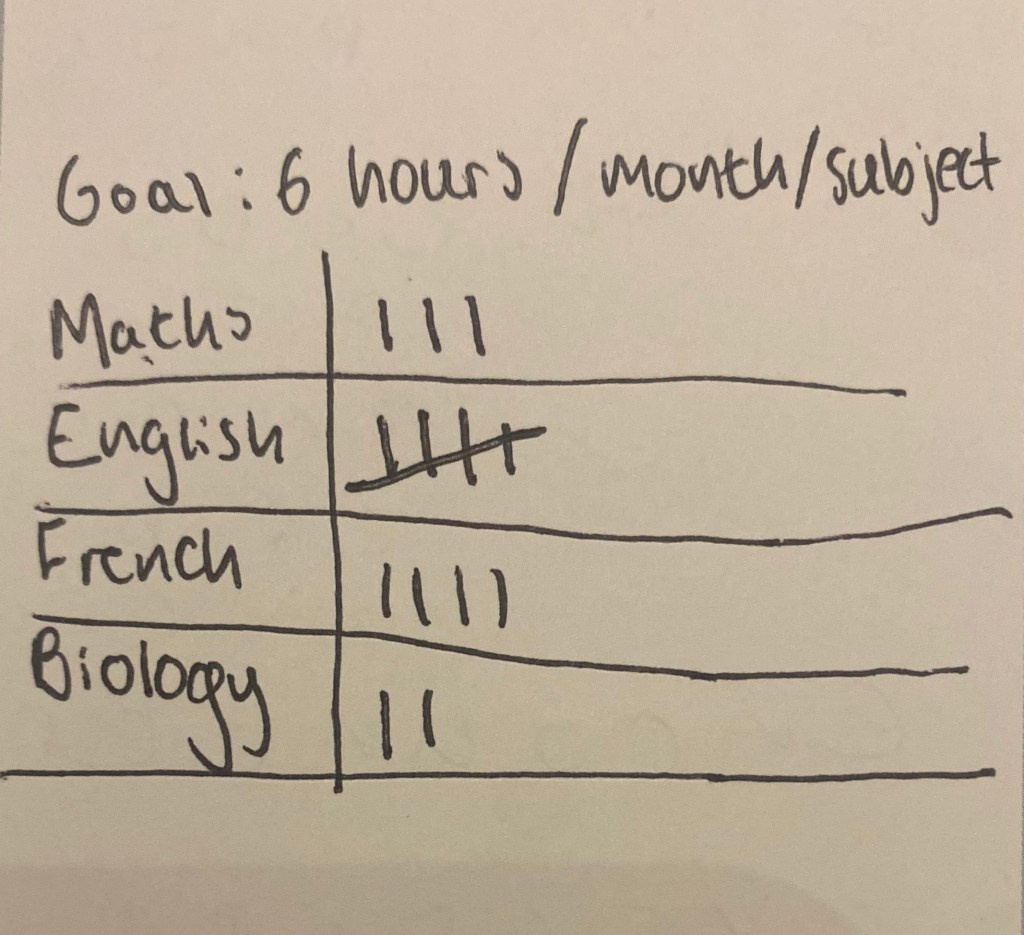
A problem I often have is that the subjects I’ve planned to study on a particular day don’t match up with the subjects I actually feel like working on. That’s where flexible time blocking comes in.
Planning your time:
This method comes down to knowing how much work you want to do each day, and keeping track of what you have done to make sure you actually meet your targets, even for subjects you’re less inclined to spend time on.
Begin by writing a list of your subjects. Decide how many hours you’d like to spend on each every month, and calculate the total.
For example, I might choose to study each of my 8 subjects for 6 hours this month.
8 subjects x 6 hours = 48 hours of study this month.
Now work out how many days you’d like to study this month.
Note: DO NOT say ‘every day’ – there may be days when you are unwell, have other priorities or need a rest. Schedule in rest to give yourself flexibility and to ensure you meet your goals.
Divide the total number of hours you’d like to study by the number of study days this month to find out what you need to do each day:
If I studied 25 days that month, 2 hours each day would mean I surpassed my target of 48 total hours of study.
If I studied 20 days that month, 2.5 hours each study day would be enough.
Know exactly what you want to make progress on this month.
If you know you want to study each subject for 6 hours this month, then you can pre-select 6 topics per subject that you want to work on.
Start by reading through your subject specification (or even just the contents of your exam-board certified textbook!) and making a list of the 6 topics you know you find difficult.
You can decide how many topics you want to cover based on the number of hours you want to commit this month.
E.g. For my goal of 6 hours per subject this month:
French:
- prepositions
- the present tense of regular verbs
- the perfect tense
- adjectives
- the near future tense
- the conditional mood
Biology
- osmosis
- plant cells
- the water cycle
- the eye
- hormones
- bacteria
English
- Juliet quotes
- Mr Utterson analysis
- theme of the gothic
- An Inspector Calls context
- Shakespeare context
- unseen poetry practice
I will write another article telling you how to study these – for now I’ll focus on planning. However, knowing what you want to improve on this month will give each study session meaning, and help you see that you are in fact making progress. It also means that more of the study time is spent studying and less is spent procrastinating by deciding what work to do!
Implementing the plan
The key to this technique is that I’m not going to plan each study session weeks in advance. Rather, I’m going to let what I feel able to happy to revise that day guide my choices.
Now that I’ve decided on time goals for the month, and on a list of topic priorities, I’m going to allow myself to plan each day individually. This means that, instead of saying ‘next Thursday I will study biology, English and maths, and on Friday I will do PE, RS and Chemistry’, I will simply focus on the short term in the knowledge that my tracking system will ensure that all content is covered.
Personally, I like to plan my days in the morning. Some people do it the night before, though, and you should do it the way that works best for you.
When planning my day I look at my commitments for the day and decide if it is a study day or a rest day. If it is a study day, I will also plan when and where I will choose to study. Next, I will look at my list of topics and decide on those that I will be tackling today depending on how I’m feeling.
When I get to work, I will add a tally to my list of subjects each time I have studied a subject of half an hour. This allows me to keep track of the subjects I jave and haven’t put time into this month, and whether I’m meeting my goals or not.
If I notice that I’m not putting enough time into a particular subject, I will try my best to commit more time to it. The ‘eat the frog’ method, by which you do your hardest subject first, can help! Personally, I like to remember that I can do a particular subject for just half an hour if I find the idea of a whole hour overwhelming, so you could even try doing half an hour of your hardest and then half an hour of your most confident subject to help yourself stay motivated.
How should I study?
I will write another article explaining how to go about studying different subjects. However, this post should have shown you how to plan your time in a flexible way if you don’t like revision timetables, and how to work out the topics you’re going to study.
It’s important to know that no plan is bullet-proof. Life happens, after all. However realistic a plan is, things might happen that mean that you don’t meet your goals every day – illness, friendship troubles, unexpected family commitments, good or bad news… the list goes on. As such, I don’t believe in ‘making up time’ – if you miss a day of study, simply pick yourself off, dust off the disappointment and get going with your next study day when you are able.
Good grades aren’t about perfection, nor about studying every day. Good grades are about having a plan and realistic goals that you work towards whenever you are able, and making progress little by little. If you work with your brain and study in a way that works for you, in quantities that work for you, there’s no reason why you shouldn’t make the progress you want to make.
Good luck!
 Lively Words
Leave a comment